What we carry
Notes from the Camino

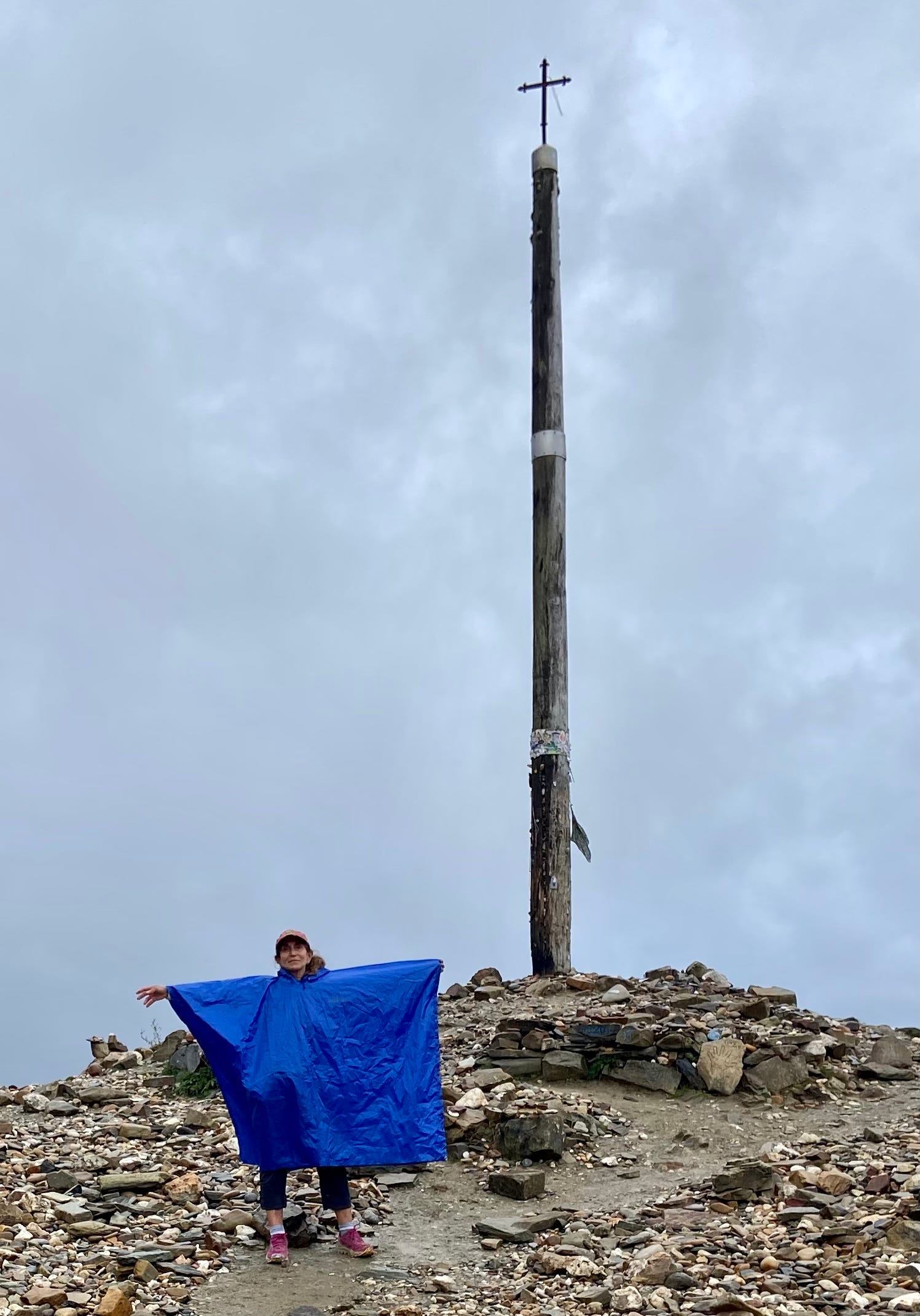
In the late morning, in the steady rain, in silence, Kiki and I make the final ascent leading to the Cruz de Ferro, the Iron Cross. Kiki had told me earlier that this spot was a significant landmark with deep meaning for pilgrims. It was, she said, one of the most iconic and emotionally charged markers on the 500-mile trek. It signified both a literal and figurative peak for pilgrims, a place of deep contemplation and prayer, a symbol of faith and humility.
What I see in front of me has none of the splendor and gravitas I was anticipating. It is just a very tall wooden pole with a simple metal cross mounted on top. It is modest—except for its sixteen-foot height—unadorned, artless, inelegant, sitting atop a very large mound of stones.
Kiki had told me that pilgrims leave a memento at the cross, something they’ve brought from home, something that represents their struggles and burdens, the literal weight of past pain. The act of carrying it and then leaving it behind symbolizes the shedding of this burden, a spiritual cleansing, perhaps even, for the believer, absolution.
I knew nothing of the cross itself as a marker on the journey, and I knew nothing about its significance. But I knew quite a lot about carrying burdens.
In my backpack, not as burden but as companion, is a stone of Tom’s given to him by a Qero shaman in Peru as well as a metal cuff bracelet stamped with Lizzie’s name. And there I was, at the Cruz de Ferro, with these two items I had carried on my back for more than two hundred miles. And here in front of me was this hallowed spot where thousands of pilgrims had placed commemorative items believing that, in adding them to the pile, they were relinquishing their worries or troubles to a higher power.
There have been times I wished I believed in God, and this is one of them.
Heavy rain is coming in sideways. The wind is whipping my plastic poncho, making sails of the sides. I would like to keep walking, to head down to the next village to get out of the weather and sit quietly with a café con leche. But I know I must stop to leave Tom’s stone and Lizzie’s bracelet on the mound.
As I climb the massive pile leading to the cross, I can see that among the rocks and stones are beads and flags, ribbons, photos, poems and letters and prayers on slips of paper. There is a small stuffed teddy bear. There is a lock of hair. So many bits and pieces of so many lives.
I don’t think I appreciated until this moment that, although I have approached the Camino as a solitary expedition, an experience uniquely my own, I am in fact part of a collective journey. Of course, I know that for centuries others have walked this path. But it is seeing this heap of mementos, this pile of troubles that people have tried to leave behind that has given me a different sense of community.
I find a place for Tom’s stone and set Lizzie’s bracelet on top of it.
I think I’m supposed to say a prayer. But I don’t pray. Instead, I tell my husband and my daughter—yes, out loud—that I am leaving a bit of them here in Spain, that I think they will like it here, and that I love them.
Of course, I am crying.
This is melodramatic. I know this as I do it, but I do it anyway.
The rest of that day, as I walk down, down, down along narrow winding paths, the sky as changeable as my mood—dark and foreboding, clearing and bright, then thick with rain clouds once again—I think: Did I leave anything behind when I left those items on the mound by the cross? Did I leave behind pain, grief? Guilt? Anger? Am I unburdened?
You have just read an excerpt from my new/ upcoming (Feb 24) book, Everything Changes Everything: Love, Loss, and a Really Long Walk. More about the book and how to order is here.
My dear Lauren, I cannot recall ever being moved by such magnificent prose. Your words always touch my soul at its core but this time, like when you placed those items, my eyes are not dry. I am so blessed to know you and your art of the written word. 🙏❤️
I loved this essay. So many burdens we may carry—physical items tasked with meaning and others existing only in our hearts.