Talking to the Screen
On loneliness, storytelling, and the strange comfort of an audience that isn’t quite real

It’s my own fault.
My scrolling and clicking and viewing and revisiting have shaped much of what now shows up in my social media feeds.
I don’t mind all the videos of sumptuous first-class seating and BVLGARI amenity kits and rare white sturgeon caviar on Emirates. I love the guy who answers every question by defaulting to his love of cheese. The guy who dresses in a bad wig and takes his partner (that would be him, sans wig) to task for his lack of empathy and emotional intelligence? Love that. And Maggie Weber who posts and comments on embarrassing business names and unintentionally vulgar logos? Oh yes. Give me more. And while cat videos are so yesterday, I cannot resist that guy who goes through his feline’s purse to find a MasterCat credit card, a tube of black lipstick, and a very small pocket knife.
That’s the good news. That’s the fun stuff.
But lately—my fault—the reels that have been showing up are (mostly) young women sobbing in their cars as they relate their (mostly) horrific cancer “journeys.” Sometimes they post from hospital rooms, just recovering from or going into surgery. They relate scary biopsy findings and scans that show new mets and chemo that no longer works. And it is all heartbreaking. And compelling. I am also getting an extraordinary number of videos made by mothers who have given birth to babies with severe disabilities or life-threatening conditions or rare incurable diseases.
And I wonder why.
Not why I’m seeing them—I understand that, and take responsibility for it—but why they are making them. Every day, sometimes.
Some creators say they are compelled by a desire to help others in similar situations or to bring awareness to struggles often hidden. This is admirable. But surely some of it is also driven by loneliness or depression—a need to tell, and no one close enough to listen.
But it’s more complicated than that. Because these women are not speaking into a void. They are speaking into a kind of vast, invisible room filled with strangers who witness, respond, return. It’s messy, sometimes performative, sometimes raw, sometimes monetized—but it is also a form of being seen.
But what kind of witnessing is this? What kind of companionship?
I think something else is going on underneath this, interwoven with it. And I think it is connected to how many people now consider their chatbot their best friend or closest confidant.
Humans are storytelling animals. It’s how we make sense of our lives, how we learn about others, how we learn about the world. We. Tell. Stories. In telling our own stories—to ourselves, to others—we untangle the tangles, we create order out of chaos, we find (or struggle to find) meaning out of randomness.
Increasingly we live silo-ed lives, especially those of us who work from home. Who stream our entertainment. Who get our dinner delivered to our doorstep. Increasingly, we live solitary lives. (The share of people living alone was 7.7 percent n 1940, 13 percent in 1960, and today is close to 30 percent.)
So to whom do we tell our stories? Do we have so few actual humans in our lives that our closest companions are generative AI bots? Do we have so few caring friends that we have to relate our tragic tales to strangers by talking into cellphones propped up against steering wheels?
I am more saddened and scared by this than I am by the current state of our politics. Which is saying A LOT.
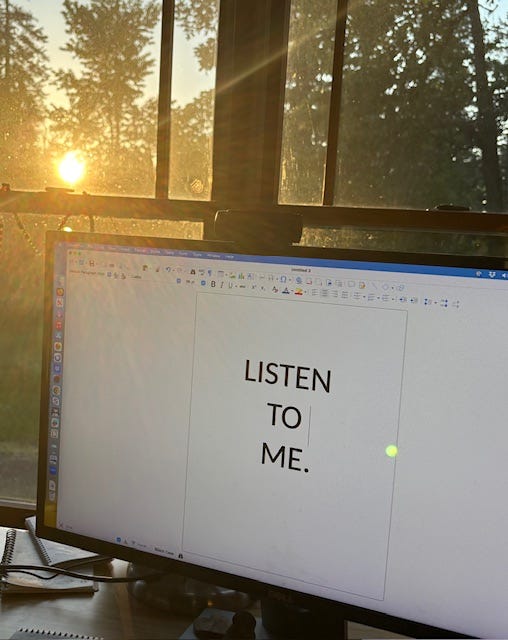
And here I am, typing this on a screen, standing in front of my computer in a room in a house where I live alone.
Telling you this.
I still can't decide how to feel about the "bubble" I've created for myself on my social media. How should I feel about the vast number of people whose lives, thoughts, and events I learn about? Who is this for me? What is this for me? Ray Bradbury's "Relatives"? I don't know.
Lauren I was so touched by the brief description of your most recent novel. Just want you to know you are not alone, even though grief is very lonely. I’ve found the more I share the story of my loss, the more I find connection. Loss is universal and grief doesn’t have to define your future, but it certainly casts its shadow.❤️