Pitching a Temporary World
Notes from an American Campground

At the campsite next to me is a couple—one is a bear of a man, maybe six and a half feet tall, luxuriantly bearded; the other is much smaller, womanly shaped, but also luxuriantly bearded. Across the path is a group of seven. They arrive together in a van towing a small trailer from which they unload seven chairs and several bundles of wood. They place the chairs in a circle, build a campfire, and sit quietly for hours. The three women are wearing ankle-length skirts and little white caps. The four men, all short-haired and bearded, are dressed almost identically in spotless white t-shirts and dark pants held up by suspenders. Two campsites away is a well-dressed older couple sitting in what look to be lounge chairs under the awning of their 45-foot motorhome. Next to them is a wiry octogenarian tinkering with his two-tone, 13-foot Shasta that is being held together by duct tape.
Welcome to the campground: one of the last genuinely mixed public spaces in America. Class-less. Democratic. Friendly. Safe.
I love establishing my campsite: the way I can transform a plot of dirt into a temporary home; the magic of pitching a tent, a tight roll of polyester taffeta that becomes a snug house; the making of a cozy fire; the red-and-white checked table cloth that changes a generic picnic table into my dining room table; the falling asleep to silence; the awakening to birds. All of that. But what I love most about camping is the campground itself.
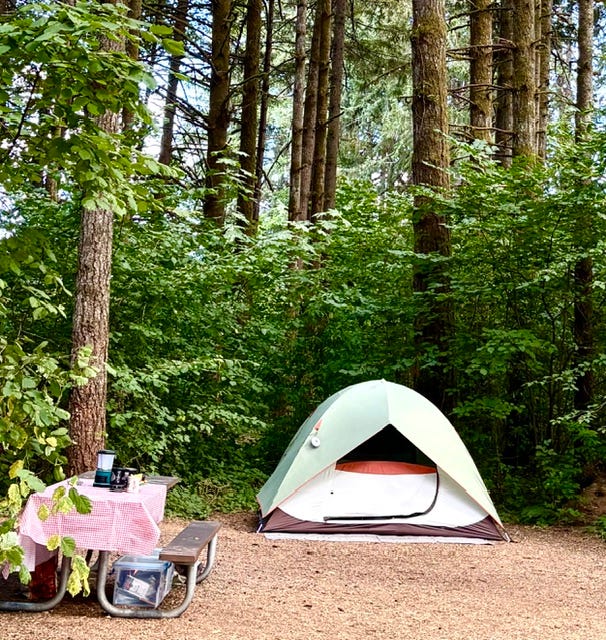
Where else in this country do we still gather like this?
Where else do we Americans experience uncurated proximity?
No algorithm chose my neighbors. No membership committee admitted them. No one asked what anyone did for a living or how they voted or what god, of any, they worshipped.
We have plenty of spaces in this country where different people occupy the same geography—airports, Costco, interstate rest stops, hospitals, libraries, parks. But campgrounds create something different. People become visible to one another. You see them making breakfast, reading books, chasing toddlers, taking naps, hanging up wet towels on jerry-rigged clothes lines, walking dogs. You witness ordinary lives unfolding.
Campgrounds are a temporary village.
European and Latin American cities have the plaza as civic living room, a place that allows for—encourages—the gathering of strangers. American towns more often developed around commerce, our collective life defined by buying, selling, and working rather than by simply gathering. To me, the campground, almost accidentally and certainly as a second thought, creates a kind of temporary public village that many other societies have built deliberately into their urbanscape.
I love campgrounds for yet another reason: Safety.
How ironic that I feel safer in a tent in a campground than I do in a dead-bolted hotel room. I would never consider sleeping in a hotel room with the door unlocked (actually I don’t think that’s an option). You cannot lock a tent. A thin layer of fabric protects me from the bad guys, the invaders, the robbers, the rapists. Only there are none. To be clear: I realize there may be crime in campgrounds. But I have pitched a tent in campgrounds every night for three weeks from the Pacific to the Atlantic (Route 20), and three weeks from the Canadian border to the Mexican border (Route 83), along the PCT, hard by the Missouri River, and in scores of sites in Oregon, Washington, and California, and I have never experienced—nor heard from others—about any untoward incidents.
At campgrounds there is a collective trust. Everyone has tacitly agreed to the same simple rules. The temporary village is united in purpose: Everyone is here to relax, to have fun, to breathe the scent of pine and fir and incense cedar, to eat what they’d never eat at home (s’mores, fried Spam), to enjoy the freedom of not taking a shower for days.
And, for the most part, everyone is friendly. If I pass someone in the hallway of the hotel, I would never think to say hello. When I sit next to someone on a six-hour flight, we never exchange a word. At campgrounds, I learn about the Mennonite Church group across the path because I go over and introduce myself. I get a tour of the 45-foot motorhome after I stop to admire it. I sit and listen to the octogenarian’s story because I ask about his vintage camper.
For those who wonder whether Americans can still live peacefully beside people unlike themselves: Get thee to a campground!
‘Get thee to a campground’, perhaps borrowed from:
‘Get thee to a nunnery!’ uttered by the great William Shakespeare. More humorously, ‘nunnery’ often referred to a brothel, but I suspect the openness of a campground would preclude (or at least diminish) the possibility of the debauchery attending the usual operations of a brothel.
On the other hand, perhaps old Bill mightn’t have been deterred by the frocks or duct tape. But that was over 400 years ago, and pretty sure no duct tape then.
More currently, the longing stare of a 4 year old (camping with his grandparents) could be felt traversing the space between their campsite and ours. He watched while we roasted marshmellows, placing the gooey concoction atop the traditional chocolate and graham cracker. The youngster was over 50 feet away, but it was quite plain where his attention was riveted. Sadly, his grandparents either didn’t understand Smores or had forgotten the components. As you might forecast - we gestured, he checked with his captors (I mean, grandparents) and he made his way over to receive the venerated pyramid of sugar. And all was well again.
Even more currently, we could point out that the review for the campground might include the bragging rights of checking into a 5 billion star hotel.
I haven’t camped in a campground in a very long time, but you are bringing back fond memories. Thank you.