I Believe
Between the ineffable and the unbelievable

It is impossible to spend a week in Salt Lake City without contemplating belief. I mean faith. I mean what people believe in and why. I mean Mormonism.
The visual, maybe even visceral, power of the church is here. The premier temple of Jesus Christ of the Latter-day Saints, a massive 210-foot high, 253,000-square foot, six-spired, gleaming white granite structure, is somehow not dwarfed by either the 10,000-foot Wasatch Mountains or the new skyscrapers of the city. It has bulk. It has gravitas. It has meaning.
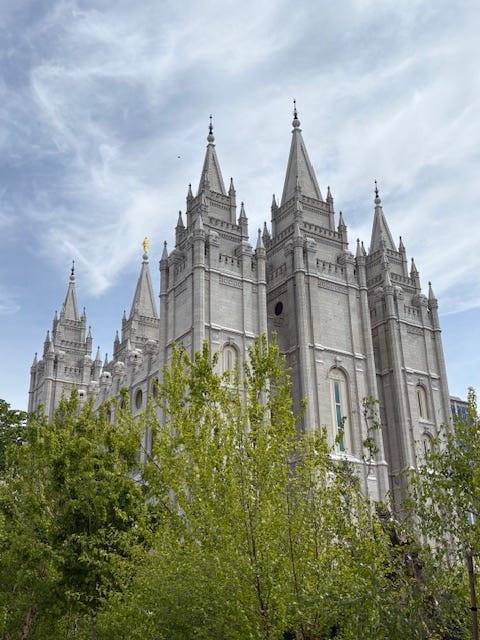
The temple makes a major statement. But downtown there is also the historic Tabernacle (home of the choir), the 21,000-seat Conference Center, the Assembly Hall, a high-rise church building, a massive Family History Library, the Beehive House (Brigham Young’s official residence), and the Lion House (home to the many sister wives of Mr. Young).
The city itself may have become increasingly (religiously) diverse as the population has soared--Mormons are actually now in the minority, perhaps 40 percent of the population--but the presence of the church is unquestionable.
The Mormon origin story is a challenge to the rational mind. It goes like this: In 1823, an Angel visits a 17 year old asleep in his bedroom, directing him to gold plates buried in a nearby hill. On these plates is text written in “reformed Egyptian” which the teen (that would be Joseph Smith) translates by placing special stones in a hat. The translated words (they appear on these “seer stones” not on the plates themselves) is a record of prophets’ (and Jesus’) spiritual journeys on the American continent, from 600BC to 400AD. This is the Book of Mormon.
I read about this on my phone, sitting on a bench in Temple Square. I shake my head. Who could possibly believe this story?
Islam has a parallel narrative to tell: a 40-year-old (that would be Muhammad) meditating in a cave receives revelations via an angel. These revelations are a direct transmission from the divine into the human language. This is the Qur’an.
Is the tale of a virgin birth any more believable?
I understand men like Joseph Smith or women like St. Teresa or St. Catherine who report visions, who have felt the presence of something big and powerful, who are transformed by an unfathomable experience. I understand because I, too, have felt this. I have felt this hiking alone on a dirt path in the forest with the early morning sun slanting through the trees. I have felt this at 35,000 feet staring out the window at a blanket of clouds.
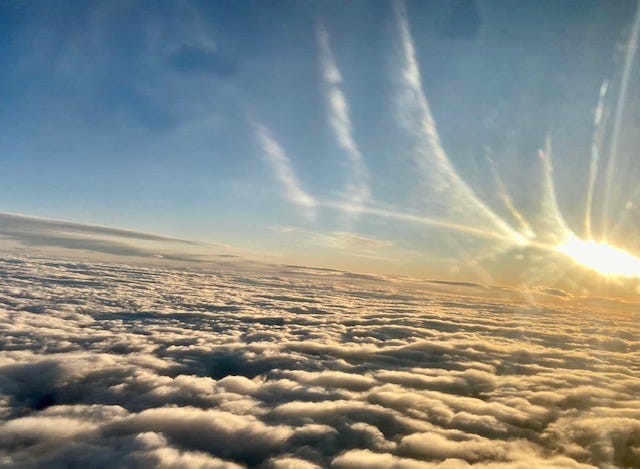
There is something. It is bigger than me. It is bigger than life. It is beyond knowing.
I understand the force of this ineffable something. What I don’t understand, as I walk the streets of Salt Lake City, is not how 17 million people believe Joseph Smith’s story, the Mormon origin tale—but how I draw the line between what feels true to me and what feels impossible.
Lauren: I first learned about Mormonism when, at 26 and fresh out of Medill's MSJ program, I escaped my mother's desire to find me a good secretarial job by becoming a copy editor at a newspaper north of Salt Lake. They interviewed me on the phone, so I knew nothing about that world until I woke up and found myself living in it the morning after a night flight from Oklahoma. I eventually became editor of the Sunday books page, which meant we ran wire except for the books I wrote about myself. One of my most memorable interviews was with Dorothy Allred Solomon, whose book In My Father's House: A Memoir of Polygamy, had just come out. Her father was a polygamist with seven wives, though she chose monogamy herself. Another book rec: No Man Knows My History: The Life of Joseph Smith by Fawn Brodie. It got the author excommunicated and is quite an amazing read. Brodie would be the one to read first.
I stopped being a Catholic at 17, much to my mother’s disappointment. At 19 I took a class in the works of Aldus Huxley that changed my entire view of religion and God. God became not transcendent but immanent in all things. I also met Allen Watts that year and became attracted to Buddhism. At 21 I became a Quaker. The “meeting” was small, less than a dozen, held in one of the member’s rustic home in the Alaska wilderness that surrounded Anchorage. The Quaker cemetery was located there by a small lake. Every meeting opened after everyone settling in with the young woman who’s house we gathered in. She would begin the meeting by quietly saying: “Be silent, and listen for the voice of God.” I still carry that gentle advice with me today, 70 years later.